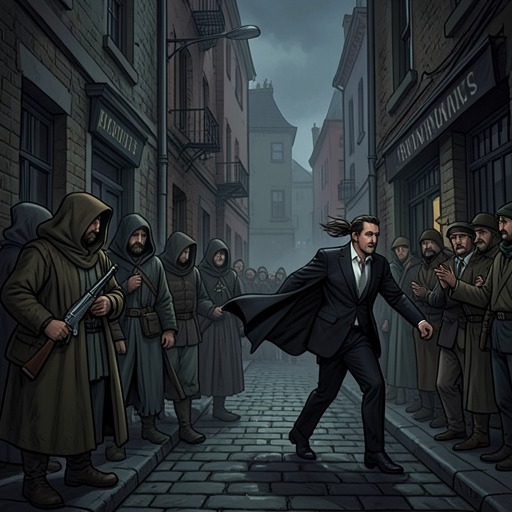
Batman vs. Mutant Gang
Batman the Dark Knight Returns 10th Anniversary Edition HardcoverBatman’s battle with the Mutants is the decisive first test of Bruce Wayne / Batman’s return. It begins as a confrontation with a gang whose size, brutality, and control of Gotham City seem to make conventional authority powerless, but it ends by breaking the Mutants’ command structure and demonstrating that Batman’s methods can still alter the city’s political and social balance.
Causes and Background
The battle grows out of Gotham City’s social decay and the Mutant gang’s expansion into a governing presence. The gang is not merely a collection of criminals encountered in isolation: its collective force has made it a direct challenge to the Gotham City Police Department and to the city’s exhausted civic order. Batman’s return therefore places him against both a physical enemy and the conditions that have allowed that enemy to flourish.
The confrontation also exposes the central risk of Batman’s renewed activity. Bruce Wayne is older and no longer protected by the institutional status he once possessed, while the Mutants possess numerical strength and the confidence that comes from ruling through fear. His decision to engage them is consequently a private act of intervention in a public crisis. The battle asks whether personal will, experience, and symbolism can overcome an organized force that has made violence its language of authority.
Course of the Battle
Batman attacks the Mutants directly rather than waiting for the city’s institutions to reclaim control. The gang’s overwhelming numbers make the encounter appear to confirm every assumption that Batman’s age has made him obsolete. Yet the fight is structured around a contrast between massed aggression and disciplined purpose: the Mutants rely on collective intimidation, while Batman uses preparation, endurance, and the psychological power of the Batman identity.
The decisive struggle is Batman’s confrontation with the Mutant Leader. The Leader embodies the gang’s authority, and defeating him matters beyond the immediate exchange of blows. Batman’s victory removes the figure around whom the gang’s violence is organized, turning a seemingly unified threat into a faction without the same commanding center. The battle therefore operates as both physical combat and a contest over who can define strength in Gotham City.
Batman’s success does not erase the damage already done to the city or make the Mutants disappear as a social force. Instead, it changes the direction of their power. Once the Leader is defeated, the gang’s previous hierarchy becomes vulnerable to reorganization, and Batman’s influence begins to extend beyond solitary crime-fighting into the management of a broader civic emergency.
Consequences and Aftermath
The defeat of the Mutant Leader weakens the Mutant gang’s rule of Gotham and creates the conditions for a new alignment of forces. Batman’s intervention gives the city an alternative to passive fear and gives the Mutants a new relationship to the figure who has beaten their leader. The immediate result is not a return to the old status quo but a destabilized transition in which Batman’s authority competes with, redirects, and gradually outlasts the gang’s authority.
The battle also establishes Batman’s renewed legitimacy through action rather than official recognition. The Gotham City Police Department and the government may treat him as an unlawful or dangerous presence, but the confrontation demonstrates that the institutions have failed to contain the crisis on their own. Batman’s victory thus creates a paradox: he violates the formal boundaries of public power while supplying the decisive response that formal power has been unable to provide.
Political and Thematic Significance
The battle presents violence as a resource that can be mobilized by different actors and converted into different kinds of authority. The Mutants use numbers and terror to impose control; Batman uses a concentrated act of force to break that control; the aftermath shows that defeating a gang is inseparable from deciding what organization will occupy the space left behind. The episode therefore links personal combat to collective mobilization and political succession.
Its deeper significance lies in the contrast between physical decline and symbolic continuity. Batman’s body is vulnerable, and the Mutants’ numerical advantage makes that vulnerability unmistakable. Nevertheless, the encounter proves that the Batman identity remains capable of gathering fear, obedience, and hope around a single decisive act. The battle is consequently more than a comeback scene: it is the moment when Bruce Wayne / Batman’s return becomes a force capable of reshaping Gotham City itself.